Related Articles



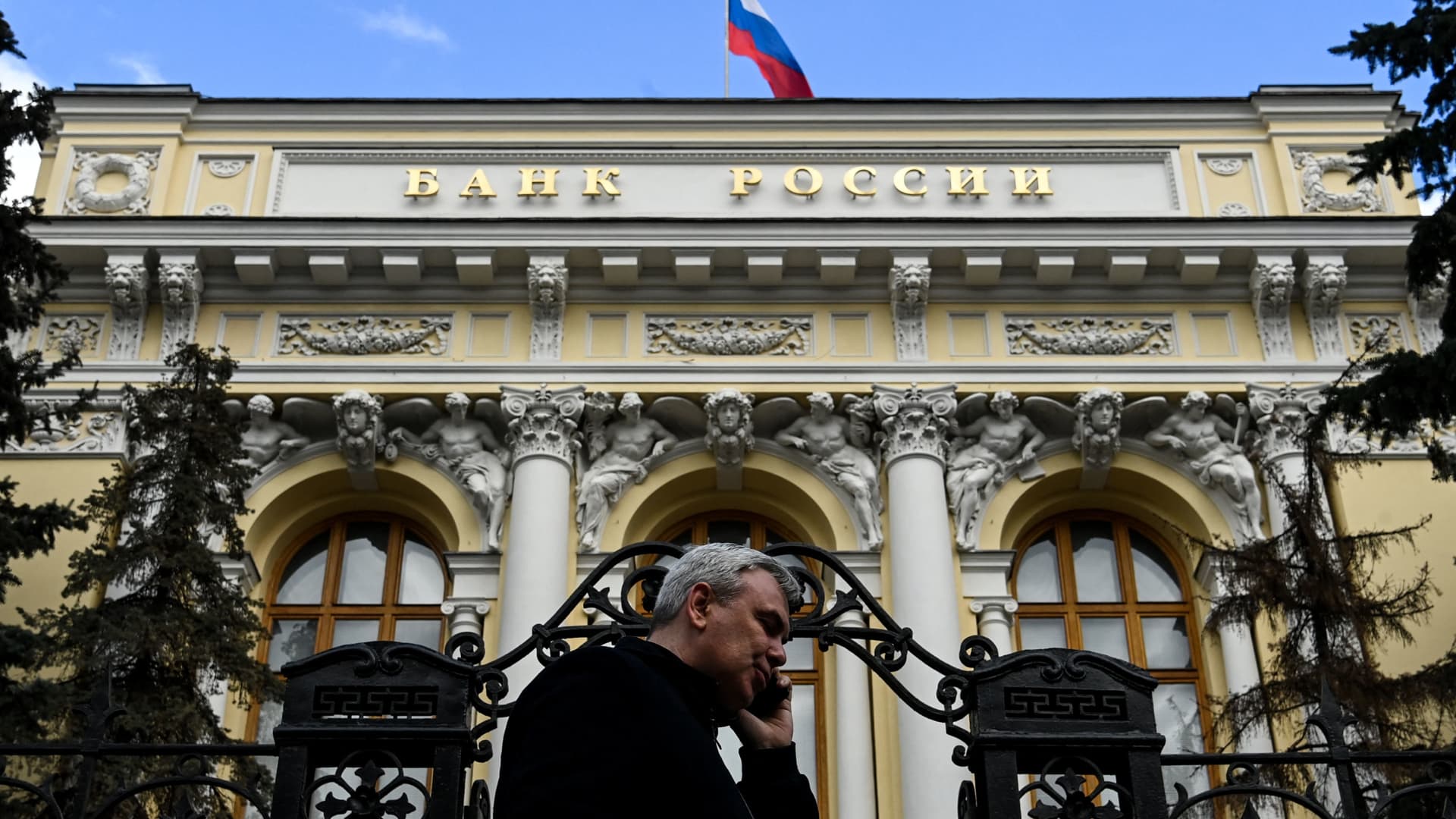
KIRILL Kudryavtsev | AFP | Getty Photographs
“Financial circumstances tightened extra considerably than envisaged by the October key rate choice,” the bank said, noting elements “autonomous” from its financial coverage.
“Given the notable enhance in rates of interest for debtors and the cooling of credit score exercise, the achieved tightness of financial circumstances creates the essential conditions for resuming disinflation processes and returning inflation to the goal, regardless of the elevated present worth progress and excessive home demand,” it added.
Markets had broadly anticipated the central bank to hike rates of interest by one other 200 foundation on Friday, after taking such a step in October amid an ongoing effort to subdue inflation stoked by the navy prices of Moscow’s invasion of Ukraine and by Western sanctions towards its key commodity exports.
The bank on Friday mentioned it will assess the necessity for a key rate enhance at its upcoming assembly in February. It at the moment forecasts annual inflation will decline to 4% in 2026 and stay at this goal within the ahead horizon.
Russia’s client worth index is at the moment greater than twice this rate — annual inflation hit 9.5% as of Dec. 16, the bank mentioned Friday, noting persisting pressures, particularly within the family and enterprise sectors. The patron worth index hit 8.9% in November on an annual foundation, up from 8.5% in October. The rise was largely pushed by rising meals costs, with the cost of milk and dairy products soaring this yr.
Inflation an ‘alarming sign’
“In fact, inflation is such an alarming sign. Simply yesterday, once I was making ready for right now’s occasion, I spoke with the chairperson of the Central Bank, Elvira [Nabiullina] who advised me that it was already someplace round 9.3%. However wages have grown by 9% in actual phrases, I wish to emphasize this — in actual phrases minus inflation — and the disposable revenue of the inhabitants has additionally grown,” he mentioned, in line with feedback reported by Interfax and translated by Google.
The Worldwide Financial Fund predicts Russia will notch 3.6% progress this yr, earlier than a deceleration to 1.3% progress in 2025.
The “sharp slowdown,” the IMF mentioned, was envisaged “as non-public consumption and funding gradual amid decreased tightness within the labor market and slower wage progress.”
“What we’re seeing proper now within the Russian financial system, [is] that it’s pushing towards capability constraint,” Alfred Kammer, director of the European Division at the IMF, said when the fund released its latest economic outlook in October.
“So we now have a optimistic output hole, or you possibly can put it in a different way — the Russian financial system is overheating. What we predict for subsequent yr is just additionally the impression that going over your provide capability, you can’t preserve for very lengthy. So we see an impression on transferring into extra regular territory there. And naturally, that’s supported by a good financial coverage by the Central Bank of Russia,” he mentioned.
“A good financial coverage, to be able to carry down inflation, slows down combination demand, and in 2025 could have these results on GDP. That is why we’re seeing the slowdown in 2025,” Kammer added.