Related Articles

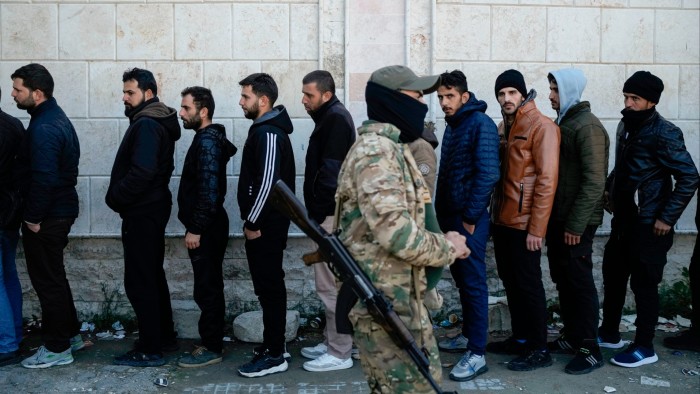
Since taking energy this month, the new interim authorities — led by Islamist insurgent group Hayat Tahrir al-Sham — has arrange a number of of those so-called settlement centres throughout the nation, placing out a name for former troopers to go to, register for non-military IDs and hand of their weapons.
They are saying initiatives reminiscent of these will assist guarantee safety and start the means of reconciliation after 13 years of brutal civil struggle that has left the nation awash with weapons and armed factions.
“An important factor is to disarm folks,” mentioned Abdel Rahman Traifi, the former insurgent now in command of the centre. “That’s the solely manner you’ll be able to assure safety.”

But in Latakia, the Assad dynasty’s dwelling province and one-time stronghold, many worry the takeover marks the starting of one thing extra sinister: a cycle of disempowerment and retribution that can depart them as losers in the new Syria.
Regardless of widespread pleasure throughout the nation, coastal Latakia is dwelling to many from the Assads’ minority Alawite sect and others who — whether or not by means of alternative or desperation — made up the troopers and loyalists who helped prop up the household’s ruthless minority rule.
In the weeks since Assad’s fall, some have closed retailers, stayed dwelling or gone into hiding amid a safety vacuum and tales of revenge killings and assaults on minorities.
“I didn’t dare go as a result of I used to be frightened about the roads,” one Alawite former safety official mentioned of the settlement centres. “They’re both going to kill us on the manner there, or in our villages.”
There has to this point been scant documentation of retributory violence, with the new powers-that-be dismissing the stories as “remoted circumstances”. Traifi, requested about rumoured situations of males at checkpoints bullying Alawites and requesting they curse the former president, mentioned these sorts of nuisance didn’t symbolize the new authorities.
“However there’s folks manning the checkpoints who’ve misplaced youngsters, wives, members of the family to bombardment and preventing, whose associates disappeared into jail. They’ve ache of their hearts,” he mentioned. “We put up with them for 14 years. They’ll put up with us for some time.”

Some troopers queueing at the Latakia settlement centre appeared to cautiously welcome the prospect of a contemporary begin, an indication of how disillusioned even nominal loyalists had develop into.
One 29-year-old former soldier mentioned he was repeatedly forbidden from taking depart to go to his dwelling over the previous 12 months as Assad’s weakening grip on the nation and its withering financial system led to rising fears that troopers would desert.
“Our life was the military, we didn’t learn to do the rest,” he mentioned, including that he was not frightened about safety. “We have now wished this for a very long time. On this new section, they only need us to dwell our lives.”
But Traifi mentioned that maybe solely 30 per cent of these arriving at settlement centres have been handing over weapons, including that an intelligence unit was working to establish and raid these nonetheless holding on to their arms. Even the former state safety worker acknowledged that either side nonetheless had arms and that, with out complete disarmament, “we’re going to have massacres inside two months”.
Earlier than the rise of Bashar al-Assad’s father Hafez to energy in 1970, Alawites have been considered one of the poorest teams in Syrian society: households dispatched their daughters to wash homes in massive cities and their sons to the army to make sure they have been supplied with meals and a gradual revenue.
However throughout its rule, the Assad household elevated a choose group of Alawite loyalists into positions of excessive authority, providing them preferential therapy above all others. Resentment in direction of the brutal enforcement of practices to make sure they held wealth, energy and political standing disproportionate to their numbers was considered one of the fundamental drivers of the 2011 protests that led to the civil struggle.
However on the eve of Assad’s fall, with a lot of these Alawites now dealing with an unsure future, 1000’s fled the capital Damascus to their ancestral houses.
The previous state safety worker mentioned he acquired a name from his superior round midnight, who instructed him to pack his belongings and go dwelling. He described apocalyptic scenes: civilians and males in fatigues crammed the streets on foot and in automobiles, their deserted weapons littering the facet of the street. “I parked on the proper facet of the street on the approach to Homs, and threw my gun in a waterway,” he mentioned.
The 2-hour journey to his village on the border with Lebanon took about eight hours on the chaotic roads. He then sheltered at dwelling, conscious that males from his village who had gone into exile in Lebanon after becoming a member of the rebels have been now returning. He feared these males have been now getting ready for vengeance towards these they blamed for massacring their family and friends.
“There’s no oversight or safety right here, so there’s nobody to cease revenge killings,” he mentioned. “There’s simply nobody right here.”
A tense quiet has hung thick in the air of Alawite villages and cities since Assad’s fall. Colleges have been open however empty. When requested if one was working, a groundskeeper mentioned: “Sure, what’s lacking is college students.”
In the Assad clan’s birthplace of Qardaha, in contrast to bigger cities, the inexperienced insurgent flag was virtually nowhere to be discovered. The inside of Hafez al-Assad’s mausoleum was coated in soot from a hearth kindled on his resting place, whereas exterior curses had been spray-painted towards him and his spouse.
Such assaults on the mausoleum have develop into “a form of pilgrimage” for insurgent supporters, mentioned one resident.


However the Alawite elite who benefited from the Assads’ rule have been a minority inside a minority. Others inside the broader Alawite neighborhood remained a few of the poorest in Syrian society, many terrorised by the identical individuals who have been finishing up crimes towards the remainder of the nation.
One 40-year-old Alawite resident of Qardaha, who requested to be recognized solely by her nickname Nana to keep away from retaliation, described how townspeople lived their complete lives in worry of their overlords, who abused folks from their very own sect and handled them with disdain.
“They wished us to remain [poor] so that individuals would hold having to enlist in the military,” Nana mentioned.
Nana and her sister taught in faculties the place youngsters couldn’t afford the meagre value of presidency schoolbooks, whereas her brother-in-law had spent the previous 14 years evading army service.
But regardless of their disillusionment with the Assads, minorities reminiscent of the Alawites and Christians worry not solely for their security however that the new rulers will impose a brand new and unfamiliar social order.
Nana’s household make and promote alcoholic drinks together with arak and wine, which weren’t restricted beneath the Assads, and like many others they’d borrowed cash to top off forward of December, the busiest time of 12 months. However after they awoke to the information that the Assad regime had fallen to the Islamist HTS, the household went to pack up their provides and take down the store signal as a precaution.
When Nana’s husband later requested an armed man patrolling the city if he might reopen, he was instructed that promoting alcohol was forbidden in Islam. The household, like others, is awaiting readability from the new authorities on what’s authorized and what’s not.
“We purchased inventory like loopy and now it’s going to take a seat in our retailers,” her brother-in-law mentioned, including that his niece was instructed off by one other patrolman for carrying pyjamas exterior.
Whereas they’d suffered “humiliation” beneath the Assads, he mentioned, they no less than knew to how manoeuvre beneath the regime. “Now, we don’t know what [kind of regime] we’ve,” Nana mentioned.
Cartography by Aditi Bhandari
